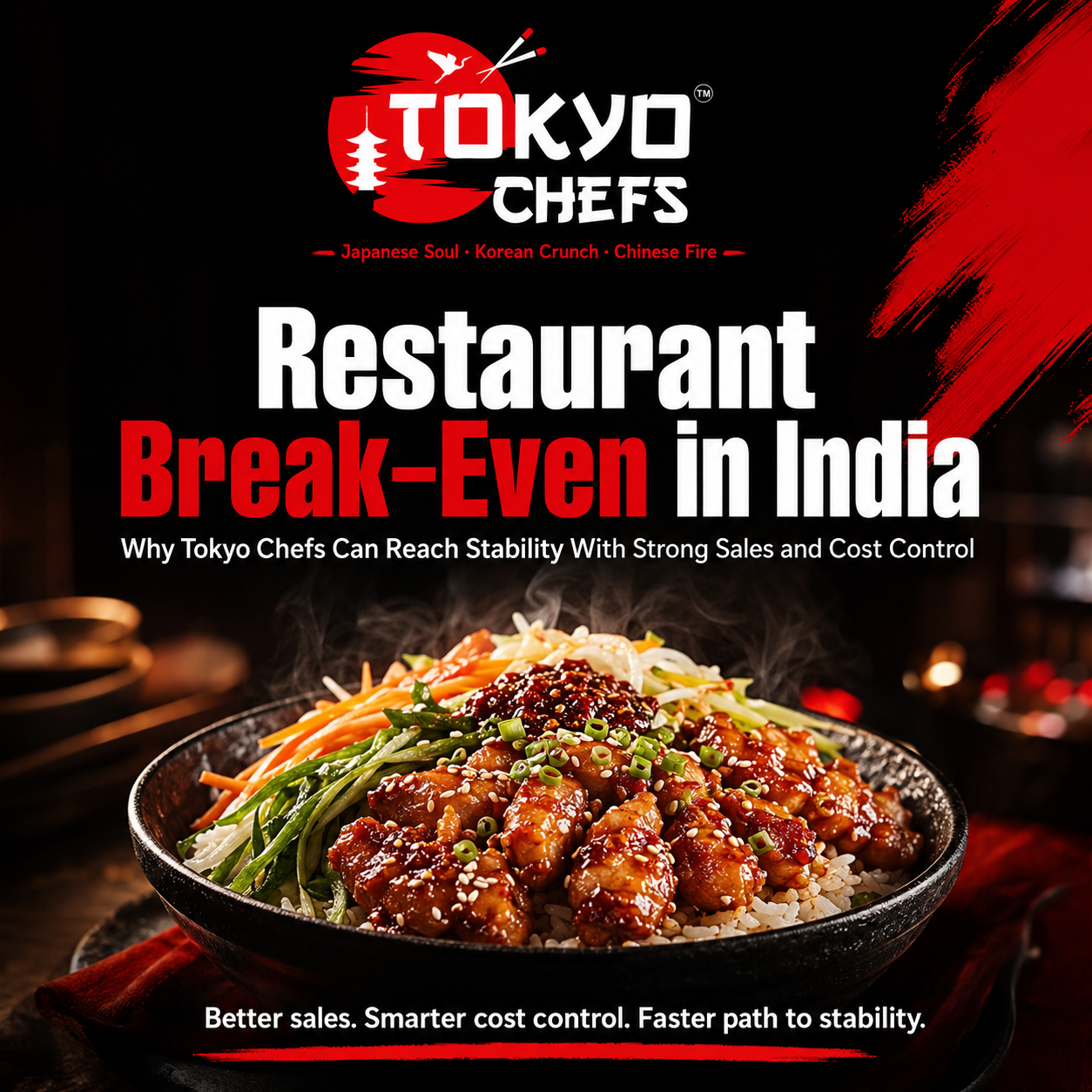
Restaurant Break-Even in India: Why Tokyo Chefs Can Reach Stability With Strong Sales and Cost Control
Break-even is one of the most important milestones in any restaurant business. It is the point where the restaurant earns enough revenue to cover its monthly expenses. After this point, the business can start moving towards profitability. For every entrepreneur investing in a food brand, understanding break-even is very important because sales alone do not mean success. A restaurant must earn enough to cover food cost, rent, salaries, electricity, packaging, delivery commissions, marketing and other operating expenses.
Tokyo Chefs can be planned as a smart Asian fusion restaurant model with strong break-even potential when the location, format, menu, pricing and operations are designed properly. The brand offers Japanese-inspired bowls, Korean fried chicken, Chinese wok rice and noodles, ramen, bao, dimsum and Asian fusion starters. This gives the business multiple sales drivers and helps reduce dependency on one single product category.
The first factor that affects break-even is investment format. A large dine-in restaurant may need higher monthly sales to break even because rent, interiors, staff and utilities are higher. A compact QSR, food court counter, takeaway outlet or cloud kitchen may have lower monthly expenses and may reach break-even faster if sales are consistent. Tokyo Chefs has the flexibility to work in different formats, which allows entrepreneurs to choose a model based on their budget and market demand.
The second factor is rent. Rent is one of the biggest fixed costs in a restaurant. If rent is too high, the outlet will need very high monthly sales to survive. Tokyo Chefs should be launched in locations where the rent is practical compared to the expected revenue. A premium location is useful only when the footfall, delivery demand and customer spending justify the cost. A smaller outlet in the right catchment can sometimes perform better than a large outlet in an expensive location.
The third factor is food cost. Food cost must be controlled carefully if the outlet has to reach break-even. Tokyo Chefs can manage food cost through standard recipes, fixed portions and ingredient cross-utilisation. The same sauces, vegetables, rice, noodles and proteins can support multiple dishes across the menu. For example, Korean sauces can be used in fried chicken, bao, rice bowls and paneer bites. This reduces wastage and improves kitchen efficiency.
The fourth factor is staff cost. A restaurant with too many employees will struggle to break even unless sales are very strong. Tokyo Chefs can be designed with efficient kitchen stations and trained multi-skilled staff depending on the format. A compact QSR or cloud kitchen does not require the same staffing level as a full-service restaurant. Clear SOPs and proper training can help the outlet operate with better control.
The fifth factor is average order value. Break-even becomes easier when customers spend more per order. Tokyo Chefs can increase average order value through smart combos and add-ons. A customer ordering a rice bowl may add dimsum. A ramen customer may add bao. A Korean fried chicken order can be upgraded with noodles or fried rice. Combos such as Korean Chicken with Noodles, Rice Bowl with Dimsum, Ramen with Bao and Family Asian Fusion Boxes can help improve billing.
The sixth factor is repeat customers. A restaurant cannot depend only on new customers. Marketing can bring trial, but repeat orders create stability. Tokyo Chefs has strong repeat potential because the menu serves different eating occasions. Rice bowls can work for weekday lunch. Korean fried chicken can work for evening snacks. Noodles and fried rice can work for dinner. Ramen can work for comfort meals. Bao and dimsum can work as add-ons and small plates. This variety helps customers return for different reasons.
The seventh factor is delivery performance. Online orders can help an outlet reach break-even faster by adding sales beyond dine-in. Tokyo Chefs has several delivery-friendly items such as rice bowls, fried rice, noodles, Korean chicken bites, bao, dimsum and combos. If the outlet maintains good packaging, food quality and delivery ratings, online orders can become a strong support channel.
The eighth factor is menu pricing. Pricing should be attractive for customers but also strong enough to protect margins. Entry-level items can help customers try the brand, while premium items and combos can improve average bill value. Tokyo Chefs should avoid underpricing hero products just to attract short-term sales. The pricing must support food cost, packaging, commissions and operating expenses.
The ninth factor is wastage control. Wastage directly delays break-even. If vegetables spoil, sauces are overproduced, proteins are mishandled or portions are uncontrolled, the outlet loses money every day. Tokyo Chefs should use daily stock checks, preparation planning, batch control and sales forecasting to reduce wastage. A disciplined kitchen improves break-even chances.
The tenth factor is local marketing. A new restaurant must create awareness quickly. Google Business Profile, food delivery platform listings, Instagram content, local influencer tastings, college promotions, office lunch campaigns and launch offers can help generate early sales. However, marketing should not depend only on discounts. Tokyo Chefs should promote hero dishes, combos, freshness, Korean fried chicken, ramen, rice bowls and Asian fusion variety.
Break-even also depends on customer experience. If customers receive good food, good packaging, proper portions and consistent taste, they are more likely to reorder. If the first experience is poor, the brand may lose them permanently. Tokyo Chefs must focus on making every order strong because each repeat customer reduces marketing pressure and supports monthly stability.
For franchise partners, break-even should be treated as a disciplined target, not just a hope. Daily sales must be tracked. Food cost must be monitored. Staff cost must be controlled. Delivery ratings must be checked. Slow-moving items must be reviewed. Local marketing must continue after launch. The outlet should be managed with data, not assumptions.
Tokyo Chefs can reach break-even faster when the business is planned realistically. The format should match the market. Rent should be practical. Menu should be engineered. Staff should be trained. Packaging should protect quality. Marketing should create awareness. Operations should maintain consistency.
Break-even is not achieved by one good weekend or a few high sales days. It is achieved through steady performance, repeat customers and cost discipline. Tokyo Chefs has the right foundation because it offers attractive Asian fusion food with multiple sales opportunities. With Japanese soul, Korean crunch, Chinese fire and Indian market understanding, the brand can be planned as a strong restaurant model with practical break-even potential.