Food Business With Low Investment in India: Why Tokyo Chefs Can Work as a Smart Compact Restaurant Model
Many entrepreneurs in India dream of entering the food business, but one of the biggest concerns is investment. Large restaurants require heavy interiors, big kitchens, high rent, large staff teams and long setup timelines. For first-time food entrepreneurs, this can create fear and financial pressure. This is why compact restaurant models, QSR outlets, food court counters and cloud kitchens are becoming more attractive in the Indian market.
Tokyo Chefs is suitable for entrepreneurs who want a modern food business without necessarily starting with a large-format restaurant. The brand can be planned as a compact Asian fusion outlet, delivery-focused kitchen, mall food court counter, takeaway model or quick-service restaurant depending on the location, budget and market demand. This flexibility makes it a practical opportunity for investors looking for a controlled food business format.
The biggest advantage of Tokyo Chefs is that the menu is strong but operationally manageable when designed properly. The brand brings together Korean fried chicken, Chinese wok rice and noodles, Japanese-inspired rice bowls, ramen, bao, dimsum and Asian fusion starters. These dishes look premium and modern, but the kitchen can be planned efficiently through standard sauces, common ingredients, portion control and proper preparation systems.
A low-investment food business does not mean a weak brand. It means smart planning. Instead of spending unnecessarily on oversized interiors and unused space, the entrepreneur can focus on food quality, kitchen efficiency, packaging, branding and online visibility. Tokyo Chefs can be developed in a format where the investment goes into the areas that directly impact sales and customer satisfaction.
Cloud kitchen formats can be especially useful for investors who want to start with lower overheads. In a cloud kitchen, there is no need for a large dining area or expensive frontage. The business depends on delivery platforms, online ordering, food photography, packaging and repeat customers. Tokyo Chefs works well in this model because many of its dishes are delivery-friendly. Rice bowls, fried rice, noodles, Korean chicken bites, dimsum, bao and combo meals can all be packed and delivered effectively.
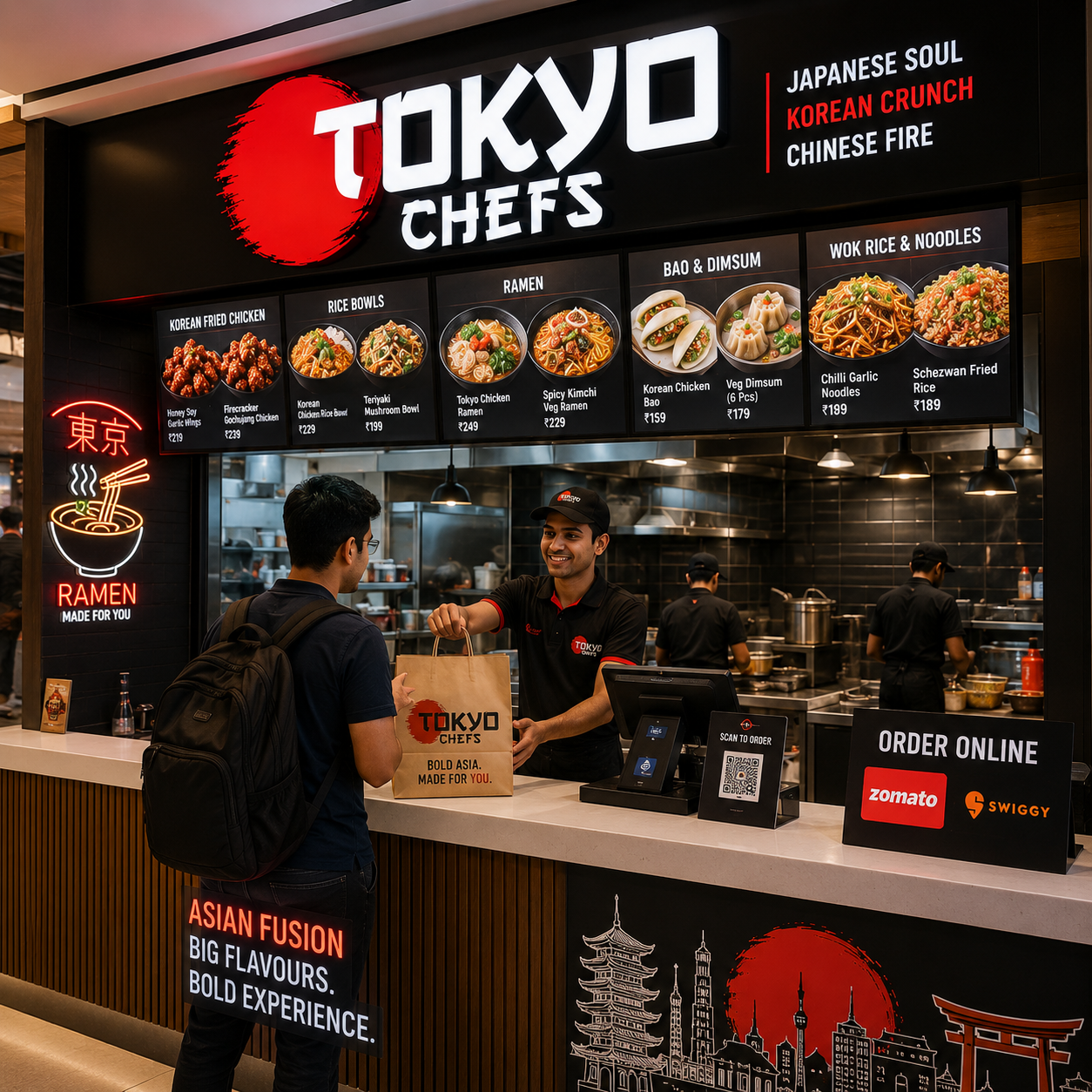
A compact QSR model is another strong option. This can work in high-street locations, student areas, office zones or busy residential markets. The outlet can have a limited seating area or takeaway-focused counter with a kitchen designed for speed. Customers can order Korean fried chicken, rice bowls, noodles, bao and dimsum quickly without waiting for a full-service restaurant experience.
Food court counters can also help reduce investment compared to independent large restaurants. Malls and commercial food courts already provide customer footfall. Tokyo Chefs can attract customers through strong menu visuals, clear branding and fast service. A food court model can focus on limited but high-selling menu items such as Korean fried chicken, rice bowls, wok noodles, dimsum and combos.
One reason Tokyo Chefs is suitable for compact formats is menu engineering. The same ingredients can be used across multiple dishes. Rice can support rice bowls and fried rice. Noodles can support wok noodles and ramen-style bowls. Korean sauces can be used for fried chicken, paneer bites, bao and rice bowls. Vegetables can be used in bowls, noodles, dimsum and starters. This reduces wastage and improves kitchen efficiency.
Sauce standardisation is very important in a compact food business. Instead of every dish requiring a completely separate preparation, Tokyo Chefs can work with controlled sauce systems such as honey soy garlic, gochujang, hot garlic, Schezwan, teriyaki, black pepper and chilli garlic. These sauces can create variety while keeping operations practical.
Staffing can also be controlled through proper SOPs. A large restaurant may need many specialised employees, but a compact Tokyo Chefs outlet can be run with a trained kitchen team, counter staff and delivery packing support depending on format. The key is training. Staff must know exact recipes, portion sizes, cooking methods, packing rules and service standards.
Food cost control is one of the biggest advantages of a system-driven compact brand. When every dish has a fixed recipe and portion, the outlet can reduce leakage, overuse and wastage. Korean fried chicken portions, rice bowl toppings, noodle quantities, sauce measurements and dimsum servings must all be standardised. This helps protect profitability even when selling at competitive prices.
A low-investment food business also needs strong branding. Customers should not feel that the outlet is small or ordinary. Tokyo Chefs can create a premium impression through its name, logo, packaging, menu design, staff uniforms, food photos and digital presence. Even a compact outlet can look powerful when the brand identity is clear and professional.
Online visibility is essential. A compact outlet may not have the same physical visibility as a large restaurant, but it can still grow through Google search, Instagram, food delivery apps and local promotions. Tokyo Chefs food is naturally attractive for digital marketing because dishes like Korean fried chicken, ramen, bao, dimsum and rice bowls look colourful and exciting.
Combo meals can help improve sales in compact formats. Customers like simple ordering decisions, and combos increase average bill value. A Korean chicken with noodles combo, rice bowl with dimsum, bao with chicken bites, ramen with side dish or family Asian fusion box can help customers order more without feeling confused.
For Tier 2 and Tier 3 cities, a compact Tokyo Chefs model can be especially practical. Investors may not want to begin with a large restaurant, but they may still want a modern brand. A focused Asian fusion outlet can introduce something new to the market while keeping setup cost under control.
The success of a low-investment food business depends on discipline. The entrepreneur must not add too many random items, overstaff the outlet, overspend on interiors or ignore food quality. Tokyo Chefs should remain focused on Asian fusion and operate with clear systems.
For customers, Tokyo Chefs offers bold, modern and fresh food. For entrepreneurs, it offers the possibility of starting with a compact, scalable and delivery-friendly restaurant model. In a market where investment control is important, Tokyo Chefs can become a smart food business opportunity by combining strong branding, efficient operations and high-demand Asian fusion food.