Best Location for a Restaurant in India: Why Tokyo Chefs Can Work Across High Streets, Malls, Food Courts and Delivery Markets
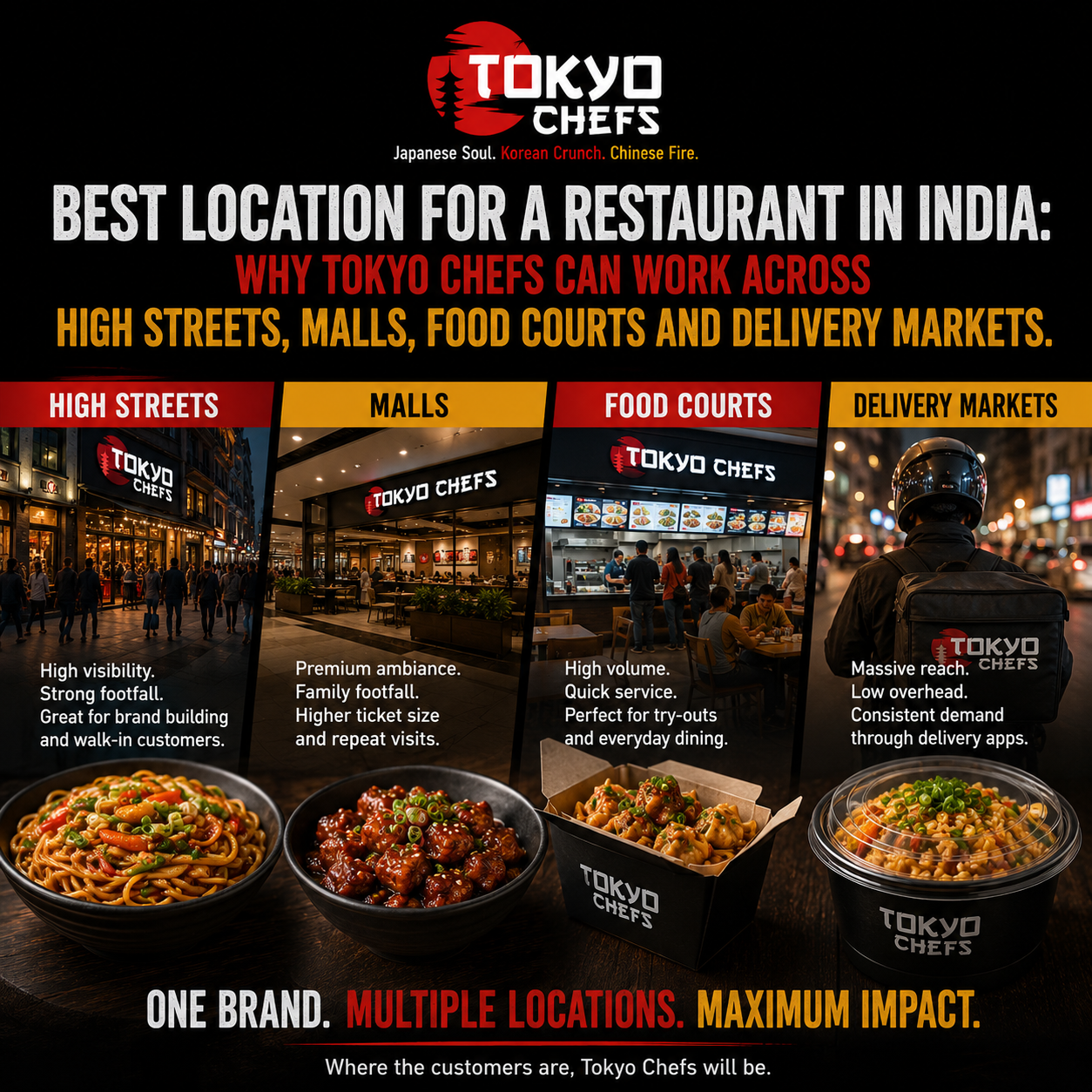
Location is one of the most important decisions in the restaurant business. A good concept can struggle in a poor location, while a well-planned brand in the right catchment can grow faster, attract repeat customers and build stronger visibility. For a modern Asian fusion brand like Tokyo Chefs, location selection must be done carefully because the brand can work in multiple formats, but each format needs the right market understanding.
Tokyo Chefs is designed around Japanese-inspired bowls, Korean fried chicken, Chinese wok rice and noodles, ramen, bao, dimsum and Asian fusion starters. This menu has wide appeal, but the outlet format and location must match the target customer. A high-street location, mall food court, cloud kitchen, office area, college zone and residential delivery market can all work differently. The success depends on choosing the right model for the right place.
High-street locations can be very powerful for Tokyo Chefs because they offer visibility and direct customer access. A high-street outlet in a busy commercial or residential area can attract walk-in customers, takeaway orders and online delivery. The brand signage, food aroma, menu board and customer movement can create strong local awareness. Korean fried chicken, rice bowls, noodles and bao can perform well in such locations because people can quickly understand and order them.
For high-street outlets, frontage is important. Tokyo Chefs should be visible from the road or main walking path. The signage should clearly communicate the brand identity. The tagline “Japanese Soul. Korean Crunch. Chinese Fire.” can help customers immediately understand that this is a modern Asian fusion kitchen. Good frontage can reduce marketing pressure because the outlet itself becomes a daily advertisement.
Mall locations are also suitable for Tokyo Chefs, especially in cities where young customers and families visit regularly. Malls attract people who are ready to spend on food, try new brands and enjoy social dining. Tokyo Chefs can perform well in malls because the menu is colourful, modern and visually attractive. Korean fried chicken, ramen, bao, dimsum and rice bowls can stand out among regular pizza, burger, biryani and Chinese counters.
In a mall, speed is very important. Customers may be shopping, going for a movie or dining with family. They want quick service and easy menu decisions. Tokyo Chefs can use clear menu boards, combo meals and attractive food photos to convert mall footfall into orders. Rice bowls, fried rice, noodles and Korean chicken combos can work especially well in food court environments.
Food courts are practical for franchise partners because they come with ready footfall. However, competition is also high. Customers compare multiple brands before ordering. Tokyo Chefs must stand out through strong visuals, clear categories and quick service. The food should look better, smell better and feel more exciting than ordinary food court options. A steaming ramen bowl or glossy Korean chicken image can attract attention quickly.
Cloud kitchen locations are different. In a cloud kitchen, physical visibility is less important. The focus is on delivery radius, online demand, kitchen efficiency and packaging. Tokyo Chefs can work well as a cloud kitchen in areas with strong residential, office, hostel or student populations. The menu has many delivery-friendly products such as rice bowls, noodles, fried rice, Korean chicken bites, dimsum and bao.
For a cloud kitchen, location should be selected based on delivery potential. The kitchen should be close enough to high-order areas so food reaches customers quickly. If the delivery distance is too long, ramen may lose heat, fried chicken may lose texture and the overall experience may suffer. A strong delivery location helps protect food quality and improves customer ratings.
Office areas are excellent for Tokyo Chefs because rice bowls, noodles, soups and combos can become regular lunch orders. Working professionals usually want food that is quick, filling and not too complicated. A Korean Fried Chicken Rice Bowl, Chicken Teriyaki Bowl, Veg Katsu Curry Bowl or Chilli Garlic Noodles can become a strong weekday meal. Office lunch promotions and corporate tie-ups can further improve sales.
College and student zones can also be powerful markets. Young customers are open to Korean fried chicken, ramen, bao, dimsum and Asian fusion snacks. They respond well to bold flavours, attractive pricing, combos and social media content. Tokyo Chefs can create student-friendly offers, snack boxes and group combos to attract this audience.
Residential areas are important for dinner and weekend delivery. Families often order Chinese food, fried rice, noodles, starters and combo meals. Tokyo Chefs can attract them by offering familiar Chinese wok dishes along with modern Asian options. Vegetarian and non-vegetarian balance becomes very important in residential markets because family orders often include mixed preferences.
Tourist and highway locations can also be explored carefully. If the location has strong footfall, parking and visibility, Tokyo Chefs can work as a quick-service Asian food stop. However, the menu may need to focus on fast-moving items such as rice bowls, noodles, fried rice, Korean chicken and bao instead of too many complex dishes.
Before finalising any location, catchment analysis is important. The brand should study customer profile, age group, spending capacity, nearby colleges, offices, residences, malls, competition, delivery demand and rental cost. A beautiful location with high rent may not always be profitable. A compact location with strong delivery demand may sometimes perform better.
Rent must be controlled carefully. Many restaurants fail because rent becomes too heavy for sales. Tokyo Chefs should choose locations where the expected revenue can comfortably support rent, staff cost, food cost, delivery commission, utilities and marketing. The location should not only look attractive; it must make business sense.
Competition should also be studied. If the area already has many Chinese outlets, Tokyo Chefs can still enter by positioning itself as a better Asian fusion brand with Korean fried chicken, ramen, bao and bowls. If the area lacks modern Asian food, the brand can become an early leader. The strategy should change based on the market.
The best location for Tokyo Chefs is one where customers are open to modern food, delivery demand is strong, visibility is good, rent is practical and the format matches the catchment. The brand does not need the same model everywhere. It can operate as a QSR in one market, a food court counter in another, a cloud kitchen in another and a casual dine-in outlet in a premium catchment.
Location selection is not only about finding a shop. It is about matching brand, customer, menu, investment and operations. Tokyo Chefs has the flexibility to work across different formats because its menu is modern, delivery-friendly and suitable for both meals and snacks.
With the right location strategy, Tokyo Chefs can reach young customers, families, office workers, students and delivery users across India. A strong location will bring visibility, but consistent food quality will bring repeat business. When both come together, Tokyo Chefs can become a powerful Asian fusion restaurant brand in the Indian market.
Restaurant Investment Cost in India: Why Tokyo Chefs Can Be Planned With Flexible Budget Formats
Restaurant investment is one of the biggest concerns for entrepreneurs in India. Many people want to start a food business, but they hesitate because they are unsure about the cost, risk, setup requirements and return potential. A restaurant can become expensive if the concept is not planned properly. Heavy interiors, oversized kitchens, unnecessary equipment, wrong location, excessive staff and poor menu planning can increase investment and reduce profitability.
Tokyo Chefs is designed as a flexible Asian fusion brand that can be planned according to the location, format and investment capacity. The brand does not need to operate only as a large dine-in restaurant. It can be developed as a compact QSR, food court counter, cloud kitchen, takeaway outlet, high-street casual dining format or mall kiosk depending on the business opportunity. This flexibility makes it practical for different types of investors.
The first factor affecting restaurant investment is format. A cloud kitchen usually requires lower investment than a full dine-in restaurant because it does not need customer seating, premium frontage or heavy interiors. The focus is on kitchen setup, packaging, delivery operations, online listing and food quality. Tokyo Chefs can work well as a cloud kitchen because many of its items are delivery-friendly, including rice bowls, noodles, fried rice, Korean chicken bites, bao, dimsum and combos.
A compact QSR format may require more investment than a cloud kitchen but less than a full-service restaurant. This model can include a small customer area, takeaway counter, visible kitchen, menu display and delivery support. For Tokyo Chefs, a QSR format can be powerful because customers can quickly order Korean fried chicken, rice bowls, ramen, bao, dimsum and wok noodles. The service is fast, the kitchen is focused and the brand remains visible.
A food court or mall counter can also be a smart investment format. In this model, the outlet benefits from existing footfall inside the mall or commercial space. The investment depends on kitchen size, counter design, equipment, branding and mall requirements. Tokyo Chefs can attract food court customers through colourful food images, clear menu categories and fast-moving combos.
A larger high-street or casual dining outlet will need higher investment because of interiors, seating, frontage, kitchen space, furniture, service area, washroom requirements and stronger ambience. This format can work in premium locations where customers expect a better dine-in experience. Tokyo Chefs can use such a format in areas with strong youth crowd, families, office customers and delivery demand.
The second factor affecting investment is kitchen equipment. Asian fusion food requires proper equipment for wok cooking, frying, steaming, rice preparation, noodle handling, broth preparation, refrigeration, storage and packing. However, the kitchen should not be overloaded with unnecessary equipment. Every piece of equipment should match the menu requirement and expected sales volume. Smart kitchen planning can control investment and improve efficiency.
The third factor is interior and branding cost. A restaurant does not need excessive luxury to look attractive. It needs clear branding, strong signage, good lighting, clean counters, attractive menu boards and practical customer flow. Tokyo Chefs should look modern, youthful and premium, but the investment should be controlled based on format. A compact outlet can still look powerful with good design discipline.
The fourth factor is menu engineering. A poorly planned menu increases investment because it requires too many ingredients, too many storage requirements and too much equipment. Tokyo Chefs can control investment through a smart menu where sauces, vegetables, proteins, rice, noodles and toppings are used across multiple dishes. This reduces wastage and makes the kitchen easier to manage.
The fifth factor is staffing. A large restaurant needs more staff, while a compact QSR or cloud kitchen can operate with a smaller trained team. Tokyo Chefs should be designed with clear SOPs so that staff can handle multiple tasks efficiently. Proper training reduces dependency on too many specialised employees and helps control salary cost.
The sixth factor is packaging. For delivery-focused formats, packaging is not optional. It is part of the investment and operating cost. Rice bowls, ramen, Korean fried chicken, bao, dimsum and noodles all need suitable packaging. Good packaging protects food quality and improves customer experience. Poor packaging may reduce cost initially, but it can damage ratings and repeat orders.
The seventh factor is launch marketing. Many entrepreneurs spend heavily on setup but ignore marketing. A new restaurant must create awareness before and after opening. Tokyo Chefs should invest in food photography, Google Business Profile, social media launch campaigns, local promotions, delivery platform setup, influencer tastings and opening offers. This helps the brand generate early trials and customer recall.
The eighth factor is working capital. Restaurant investment should not include only setup cost. The investor must also plan for rent deposit, staff salaries, raw materials, utilities, marketing, packaging, delivery platform commissions and daily operating expenses for the initial months. Without working capital, even a good outlet can face pressure before sales stabilise.
Tokyo Chefs can be attractive for investors because the brand can be scaled according to budget. A first-time investor may begin with a compact QSR or cloud kitchen. A stronger investor may choose a food court or high-street outlet. A premium market may support a larger dine-in format. The key is to match investment with location potential and business model.
A smart restaurant investment should focus on what directly creates sales and customer satisfaction. Money should be spent on kitchen efficiency, food quality, branding, packaging, staff training and marketing. Unnecessary spending on oversized interiors, random equipment or unfocused menus should be avoided.
Tokyo Chefs gives entrepreneurs a practical advantage because it combines modern food appeal with flexible business formats. It can be planned with controlled investment while still offering a premium Asian fusion experience. With the right location, kitchen planning, menu engineering and operating discipline, Tokyo Chefs can become a strong restaurant investment opportunity in India.